01
Move Well
Develop posture, coordination, rhythm, foot placement, arm action and efficient running mechanics.

A structured pathway for young athletes who want to improve their movement, speed, endurance and confidence through purposeful, age-appropriate coaching.
Track. Cross-country. Middle distance. Long-term development.
Expressions of interest openJunior development is not about giving young athletes adult training with fewer repetitions. It requires age-appropriate coaching, clear progression, strong movement foundations and an understanding of the athlete's experience, growth and broader sporting commitments.
The objective is not simply to make a young athlete faster today. It is to help them develop the skills, confidence and training habits that allow them to keep progressing.
01
Develop posture, coordination, rhythm, foot placement, arm action and efficient running mechanics.
02
Improve acceleration, cadence, speed control and the ability to run efficiently at different intensities.
03
Build aerobic ability progressively through training that reflects the athlete's age, experience and event demands.
04
Develop pacing, tactical awareness, confidence and the ability to execute across track, cross-country and road events.
Run Theory Juniors is being developed for athletes aged 12 to 17 across track, cross-country and middle-distance running. It may suit:
Initial registration information will help Run Theory determine the most suitable program structure and ensure each athlete is placed in an appropriate environment.
Every athlete should understand what they are working on and why it matters. Sessions will be scaled to the athlete's experience and development rather than expecting every runner to complete identical volume or intensity.
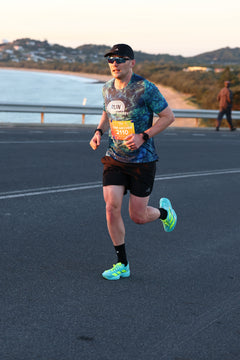
Before moving into endurance sport, Cameron competed throughout his school years as a sprint and middle-distance athlete, specialising in the 400m, 800m and 1500m and regularly winning his school athletics age championship. That early grounding in speed, movement and racing now sits alongside 15 years of experience across road running, track, triathlon and long-course endurance sport.
As Run Theory's Founder and Head Coach, Cameron is an Australian Athletics accredited Advanced Run Level 2 coach, TrainingPeaks Level 1 certified and a current Queensland Blue Card holder.
Every Run Theory coach is Australian Athletics accredited.
Run Theory does not use unaccredited coaches to deliver its coaching services. Every coach working with junior athletes must also hold a current Queensland Blue Card and meet Run Theory's child-safeguarding requirements.
Run Theory Juniors is intended to complement existing club, representative and organised sporting involvement. Training decisions should consider the athlete's total workload across running, school, club sport and other commitments.
Run Theory Juniors is being developed for athletes aged 12 to 17. Suitability will depend on the athlete's experience, goals, maturity and current sporting commitments.
Not necessarily. The program is intended to support developing through to representative athletes. Registration information will help determine the most suitable starting point.
The initial focus is running development across track, cross-country and middle-distance events, including the 400m, 800m, 1500m, 3000m and 5km.
No. Run Theory Juniors is specialist running development designed to complement an athlete's existing club, competition or sporting involvement.
All administrative and individual athlete communication involving a minor will include their parent or guardian. Run Theory will not use private one-to-one digital communication between a coach and junior athlete.
Yes. Every Run Theory coach is Australian Athletics accredited. Every coach working with junior athletes must also hold a current Queensland Blue Card and meet Run Theory's safeguarding requirements.
Final session structure, location, intake dates and availability will be confirmed after expressions of interest have been reviewed.
Run Theory will contact the parent or guardian when initial program details and intake opportunities are available. Registering interest does not create a payment obligation or guarantee a position.
Tell us about the athlete, their current running and what they would like to work toward. All communication will go through the nominated parent or guardian.